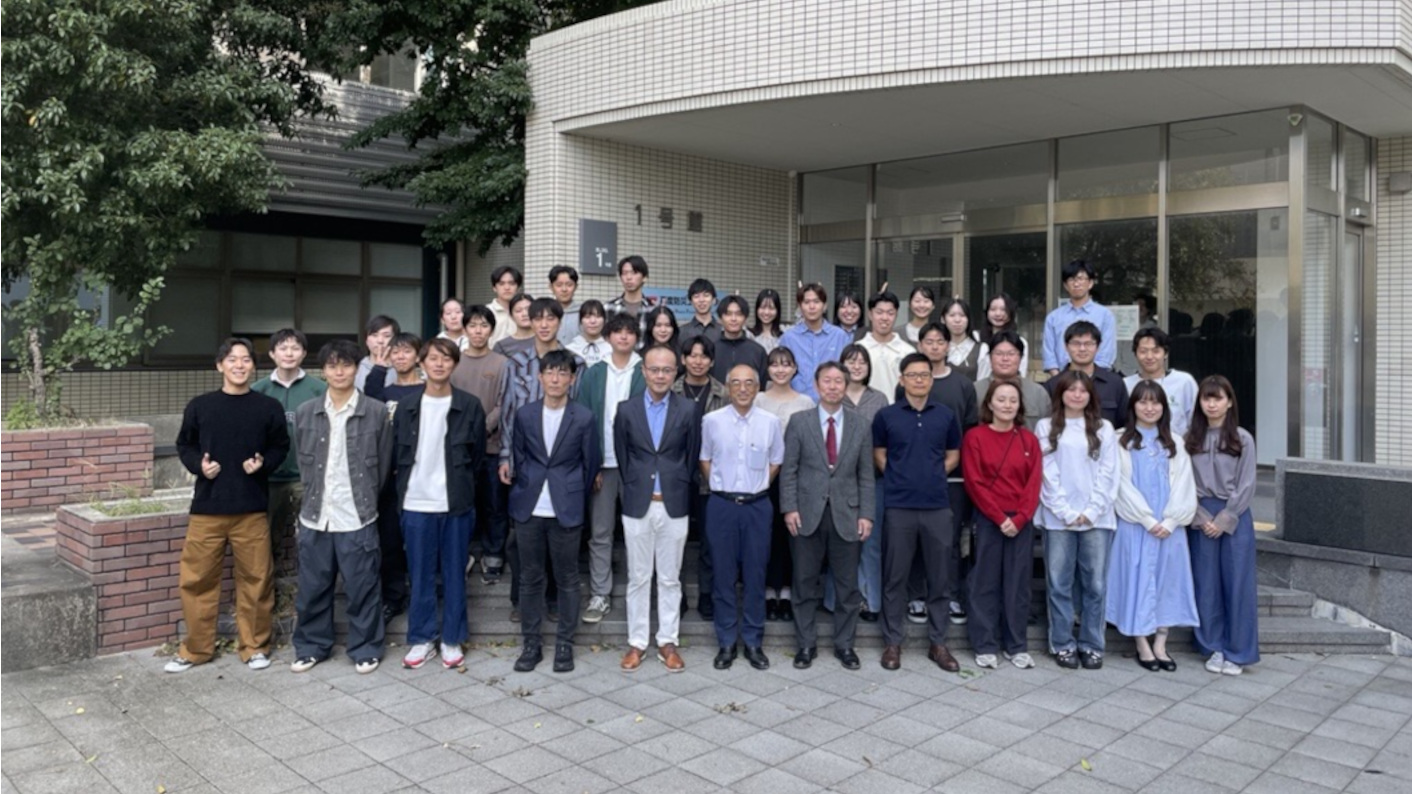
古川陽輝らの研究成果がJournal of Chemical Engineering of Japan誌にオープンアクセス論文として掲載されました。
論文タイトルは、“An Analysis of Mixing Time Correlations Across a Wide Reynolds Number Range”です。
撹拌槽内の混合時間を、層流から遷移流、乱流まで幅広いレイノルズ数範囲にわたって予測するための研究成果が、 Journal of Chemical Engineering of Japan にResearch Articleとして掲載されました。 本研究では、濃度勾配 ∇C に着目して混合時間を定義し、移流拡散方程式に基づいて各流動領域の混合時間相関式を理論的に導出しました。 さらに、脱色法による実験と既報の実験データを用いて、導出した関係の妥当性を検証しました。
論文情報 / Publication
- Title
- An Analysis of Mixing Time Correlations Across a Wide Reynolds Number Range
- Authors
- Haruki Furukawa, Noboru Kamei, Setsuro Hiraoka, Kotomi Ono, and Yoshihito Kato
- Journal
- Journal of Chemical Engineering of Japan, Vol. 59, No. 1, 2739702 (2026)
- Article type
- Research Article
- Published online
- 8 October 2026
- DOI
- 10.1080/00219592.2026.2739702
- Access
- Open Access (Creative Commons Attribution–NonCommercial License, CC BY-NC 4.0)
研究概要
混合時間は、撹拌槽内に添加した物質が均一になるまでに要する時間を表す重要な設計指標です。 従来は、混合不良領域も含めた槽全体の均一化時間に着目することが多く、 良混合領域における迅速な混合が重要な操作に適した相関式の整理は十分ではありませんでした。 また、既存の混合時間相関式は流動領域ごとに数多く報告されているものの、 層流・遷移流・乱流を横断する理論的な整理が求められていました。
本研究では、トレーサー濃度 C の空間勾配 ∇C を混合状態の評価に用い、 濃度勾配が槽内で一様になるまでの時間として混合時間を再定義しました。 移流拡散方程式に濃度勾配演算子を適用し、対流、層流せん断、乱流拡散などの寄与を考慮することで、 各流動領域における無次元混合時間 ntm の支配パラメータを導出しました。
妥当性の検証では、邪魔板付き撹拌槽(槽内径 D = 360 mm)と6枚羽根パドル翼を用い、 粘度の異なる水あめ水溶液を対象として脱色法による混合時間測定を行いました。 さらに、混合不良領域が生じない条件で取得された既報データと比較しました。
主な研究成果
- 濃度勾配を用いた理論的整理:移流拡散方程式を基礎として、層流・遷移流・乱流の混合時間を特徴づける無次元パラメータを導出しました。
- 層流領域:孤立混合領域(isolated mixing region, IMR)を形成しないヘリカルリボン翼の既報データについて、 ntm = 1.1 × 10⁴(αNpRe)−1 の関係が得られました。
- 乱流領域:邪魔板付き撹拌槽の既存の混合時間相関式と照合し、 ntm ∝(αNp)−1/3 という理論上の依存性を支持する結果を得ました。 ただし、適用範囲は翼形状などの条件に依存します。
- 遷移流領域:パドル翼について追加の脱色実験を行い、 ntm ∝(αNpRe)−1/2 に翼径比 d/D の影響を組み合わせることで、 実験データを整理できることを示しました。
- 幅広い流動条件での検証:遷移流領域を中心とする Re = 102~105 のデータを含め、 理論的に導出したパラメータと実測結果の整合性を確認しました。 ただし、提案関係は槽内に混合不良領域が生じないことを前提としています。
混合時間相関式の整理
本論文で理論的に導出した各流動領域の基本的な関係は次のとおりです(論文Table 1)。 ここで、Np は動力数、Re はレイノルズ数、 α = 4d3 / (πD2H) は幾何学パラメータです。
- 層流 / Laminar
- ntm = KL(αNpRe)−1
- 遷移流 / Transitional
- ntm = Ktr(αNpRe)−1/2
- 乱流 / Turbulent
- ntm ∝(αNp)−1/3
また、今回対象とした6枚羽根パドル翼(D = 360 mm、b/d = 0.2)の Re = 102~105 に対する実験的な相関式として、 ntm = 2.5 × 10²(αNpRe)−0.5(d/D)2 が示されています(論文Eq. (28))。この式は検証に用いた翼形状・槽条件に基づくものであり、 他の翼種や寸法比への適用には追加の検証が必要です。
本研究の意義
本研究は、経験的に提案されてきた混合時間相関式を、濃度勾配の変化を表す基礎方程式から理論的に整理したものです。 動力数、レイノルズ数および槽・翼の幾何学条件と混合時間の関係を捉える枠組みを示すことで、 流動状態が変化する撹拌装置の設計やスケールアップに向けた基礎知見を提供します。 一方で、孤立混合領域や円筒状回転領域などの混合不良領域が存在する系、 および異なる翼種や槽寸法については、今後の検討課題とされています。
Research overview
Conventional mixing-time correlations often describe the time required to homogenize an entire stirred tank, including poorly mixed regions. For processes that require rapid mixing in well-mixed regions, a correlation grounded in the mixing mechanism is also important. This study introduces the concentration gradient, ∇C, as a key variable and defines mixing time as the time required for the concentration gradient to become uniform throughout the tank.
Starting from the convection–diffusion equation, the authors derived regime-dependent parameters for the dimensionless mixing time, ntm. These relationships were examined using new decolorization experiments with paddle impellers and published measurements obtained under conditions without poorly mixed regions.
Key findings
- Regime-dependent correlations were derived using the concentration-gradient formulation, rather than relying solely on empirical relationships.
- For laminar mixing without isolated mixing regions, published helical-ribbon data support ntm = 1.1 × 10⁴ (αNpRe)−1.
- For turbulent mixing under baffled conditions, existing correlations are consistent with the predicted dependence ntm ∝ (αNp)−1/3, subject to impeller-geometry constraints.
- For the transitional regime, the theoretically derived dependence (αNpRe)−1/2, supplemented by an impeller-diameter-ratio correction, correlated experimental mixing times across Re = 102–105 for the investigated system.
- Applicability to other impeller geometries, vessel scales, and unbaffled systems with poorly mixed regions requires further investigation.
Significance
The work provides a theoretical framework connecting mixing time with power number, Reynolds number, and vessel–impeller geometry across different flow regimes. It offers a basis for developing and assessing mixing-time correlations for stirred-tank design and scale-up, provided that poorly mixed regions are absent.
Keywords / キーワード
Stirred tank; Agitation; Mixing time; Correlation; Concentration gradient
撹拌槽;撹拌;混合時間;混合時間相関式;濃度勾配;レイノルズ数;層流;遷移流;乱流;動力数
Citation
Furukawa, H., Kamei, N., Hiraoka, S., Ono, K., and Kato, Y. (2026). “An Analysis of Mixing Time Correlations Across a Wide Reynolds Number Range,” Journal of Chemical Engineering of Japan, 59(1), 2739702. DOI: 10.1080/00219592.2026.2739702.
Additional information
本論文はCreative Commons Attribution–NonCommercial 4.0 International(CC BY-NC 4.0)ライセンスでオープンアクセス公開されています。 また、本研究の一部は公益財団法人中部科学技術センターのAcademic/Mirai Grantによる支援を受けています。
Publisher page: https://doi.org/10.1080/00219592.2026.2739702